[Shu-Hsing Wu] Plant circadian clock: LWD protein complexes keep the 24-hour timeline in check
POST: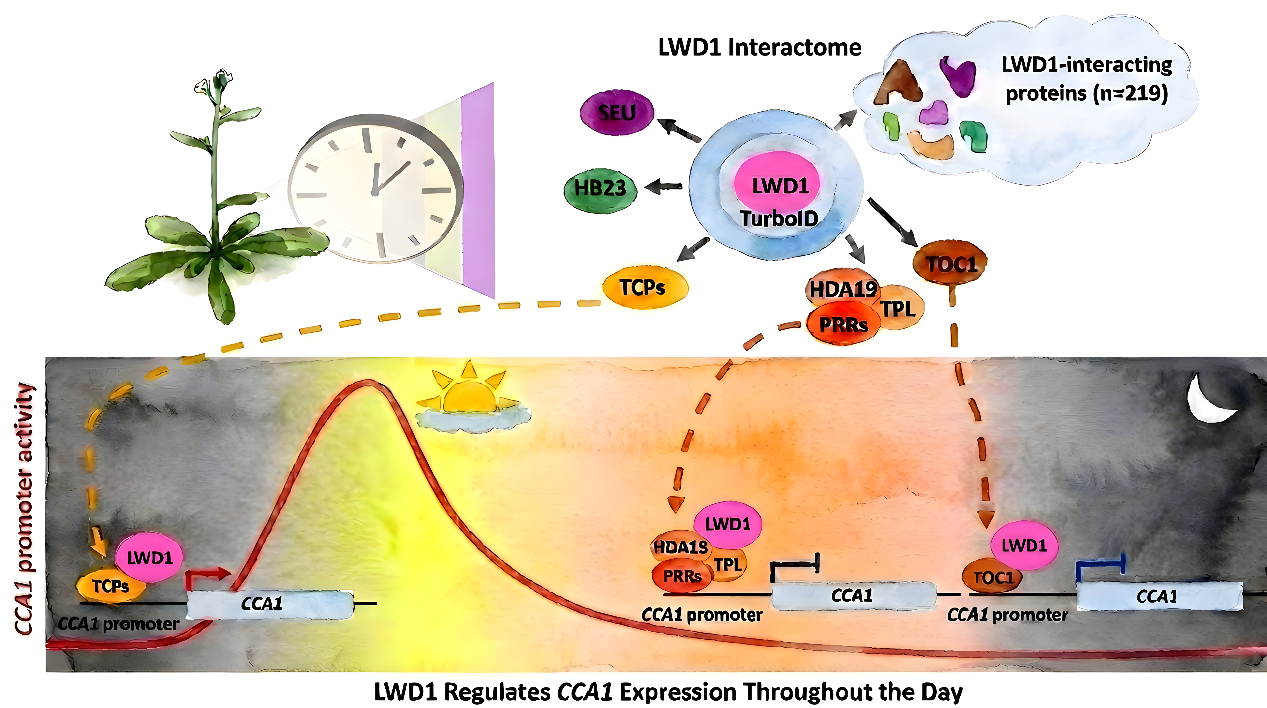
External light entrains plants to establish circadian rhythms, while plants also rely on their internal clocks to precisely anticipate daily light-dark cycles. This "internal-external synchronization" process optimizes plant development, crop yields, and environmental resilience.
Dr. Shu-Hsing Wu’s team previously revealed that LIGHT-REGULATED WD proteins (LWDs) play a critical role in maintaining a precise and robust circadian clock in Arabidopsis. LWD proteins contain multiple WD repeats that act as structural scaffolds, recruiting other proteins to assemble multifunctional protein complexes. To gain deeper insights into the composition and temporal variations of these LWD-driven protein complexes across the 24-h cycle, the research team utilized TurboID proximity labeling to successfully identify 219 LWD1-interacting proteins, including several novel circadian clock regulators. The findings reveal that LWD1 dynamically recruits distinct protein partners throughout the day to flexibly regulate circadian gene expression. For example, LWD1 interacts with TCPs to activate expression of the morning gene CCA1 at dawn. Conversely, LWD1 forms the transcriptional repression complex with PRRs/HDA/TPL to suppress CCA1 expression from late afternoon through early night, maintaining it at its expression trough. This dual mechanism ensures that CCA1 reaches its peak expression at dawn, driving the plant’s recurring 24-hour circadian clock to operate in precise harmony with external light cues.
By elucidating the diversity of LWD1 protein complexes and their dual regulatory mechanism on CCA1 expression, this study clarifies how LWD proteins sustain robust circadian clock operations and opens new avenues in plant clock research.