[Lay-Sun Ma]How a Corn Smut Fungus Hacks Plant Cell Walls
POST: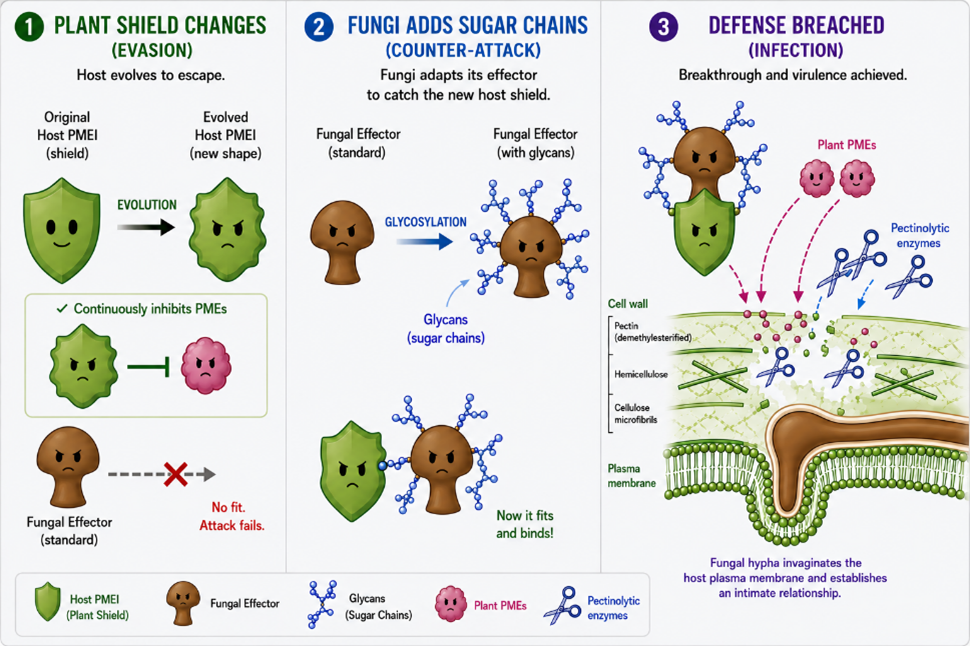
To protect themselves from disease, plants rely on complex carbohydrates like pectin to reinforce their cell walls, using molecular brakes known as PMEIs to keep this structural barrier rigid and secure against invaders. However, the UMAydis@IPMB group studying the corn smut fungus (Ustilago maydis) have uncovered how this pathogen bypasses the defense: it secretes a specialized protein called Nge1 that targets and disarms the plant’s PMEI brakes. Stripped of these controls, the plant’s own enzymes go into overdrive and break down its pectin layer, causing the cell wall to loosen and giving the fungus a clear path to colonize the host. The crucial key to pulling this off is a post-translational modification called N-glycosylation, decorating Nge1 with specific sugar chains to precisely recognize and neutralize host-specific PMEI defenses. By showing that adding these sugar tags onto related, non-functional proteins can restore their host-hijacking abilities, the study demonstrates that fungi rely on custom chemical decorations to outsmart plant immunity in the ongoing evolutionary arms race.
Chibbhi B., Teoh EY, Chau MQ, Yeh CH, Tsai WL, Teh OK, and Ma LS (2026) N-glycosylation mediates smut effector adaptation toward a host pectin methylesterase inhibitor. Plant Cell https://doi.org/10.1093/plcell/koag234