[Chih-Hang Wu, Erh-Min Lai, and Chih-Horng Kuo] Breaking Species Barriers in Gene Expression: New Opportunities for Plant Functional Genomics and Biotechnology
POST: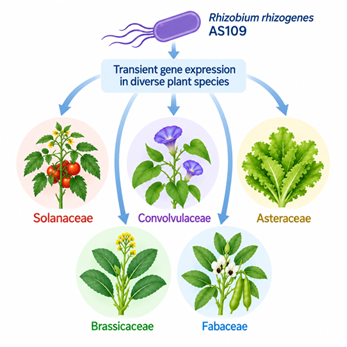
Transient gene expression mediated by agrobacteria has long been an essential tool for studying plant gene function. However, conventional laboratory strains exhibit limited efficiency in many important crops, restricting their application in plant research. Research teams led by Chih-Hang Wu, Erh-Min Lai, and Chih-Horng Kuo at the Institute of Plant and Microbial Biology (IPMB), Academia Sinica, in collaboration with Tolga Bozkurt at Imperial College London and Lida Derevnina at the University of Cambridge, have demonstrated that Rhizobium rhizogenes AS109 enables efficient transient gene expression across a wide range of crop species. The findings were published in PLOS Biology.
AS109 is a novel bacterial strain previously developed by the Academia Sinica research team through exploring the natural diversity of agrobacteria. In this study, the researchers further demonstrated that AS109 supports efficient transient gene expression not only in Solanaceae but also in diverse plant families, including Convolvulaceae, Asteraceae, and Fabaceae, substantially expanding the range of plant species amenable to functional studies.
Importantly, the team used AS109 to establish a versatile functional assay platform in faba bean, an economically important legume crop. This platform enables protein localization studies, gene silencing, pathogen infection assays, and functional characterization of plant immune receptors. By introducing immune receptors from Solanaceae into faba bean, the researchers demonstrated functional compatibility of immune recognition and signaling components across distantly related plant families, opening new opportunities for studying and deploying disease resistance genes across species.
This study overcomes longstanding species limitations of conventional transient expression systems and provides a rapid, accessible platform for functional studies in non-model crops that previously lacked efficient molecular tools. These advances are expected to accelerate gene function discovery, plant immunity research, and the development of disease-resistant crops.
The research conducted in Taiwan was supported by the Academia Sinica Grand Challenge Program and the intramural fund of IPMB. The study represents a collaborative effort among the laboratories of Chih-Hang Wu, Erh-Min Lai, and Chih-Horng Kuo at IPMB and their international partners. The two co-first authors are Freddie King, a PhD student at Imperial College London, and Juan Carlos Lopez-Agudelo, a PhD student in the Taiwan International Graduate Program at Academia Sinica.