[Chih-Horng Kuo] Genomic insights into phytoplasma effectors underlying branching in poinsettia
POST: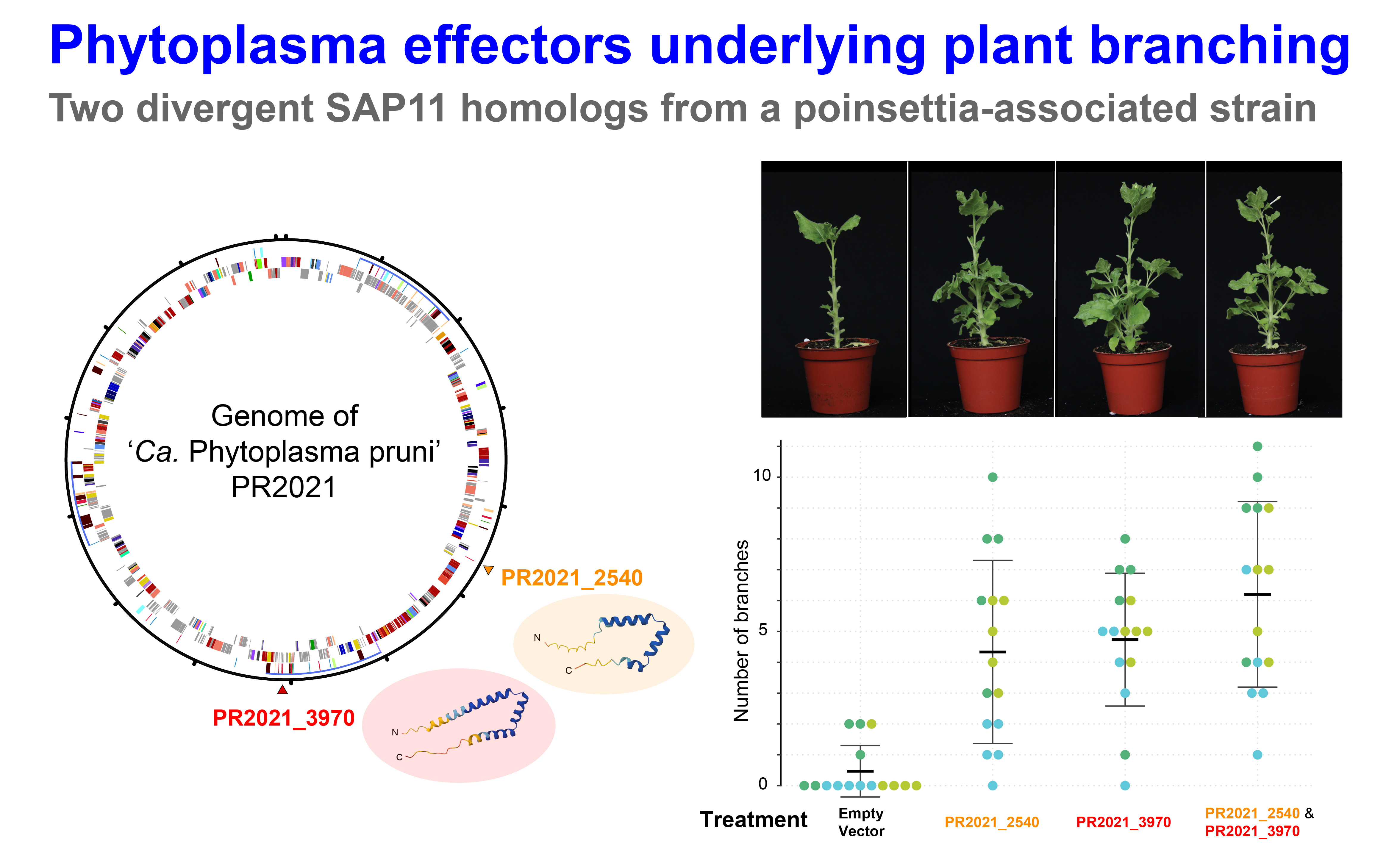
Graphical summary: Genome analysis of a poinsettia branch-inducing phytoplasma identified two divergent homologs of SAP11. Transient expression assays in Nicotiana benthamiana showed that each effector independently induces plant branching.
Phytoplasmas are insect-transmitted plant-pathogenic bacteria that alter host development through secreted effector proteins, inducing symptoms such as dwarfism, witches’ broom, shoot proliferation, and phyllody, leading to agricultural losses. However, in poinsettia (Euphorbia pulcherrima), dwarfing and branching induced by phytoplasma infections are desirable traits that improves ornamental value and propagation efficiency. As a result, most commercial poinsettia cultivars carry phytoplasmas. Yet, these phytoplasma-induced traits remain unstable for commercial production, and their underlying molecular mechanisms have not been well understood.
To address this question, Dr. Chih-Horng Kuo (Institute of Plant and Microbial Biology, Academia Sinica) collaborated with Dr. Ting-Hsuan Hung (Department of Plant Pathology and Microbiology, National Taiwan University). Through greenhouse experiments comparing traits among poinsettia cultivars, the team selected the high-branching cultivar Princettia Pink for shotgun sequencing. Based on metagenome assembly, the team obtained the complete genome sequence of the first poinsettia branch-inducing phytoplasma strain and investigated its candidate effectors potentially involved in regulating host developments.
The results showed that this strain, ‘Candidatus Phytoplasma pruni’ PR2021, encodes two SAP11-homologs, but no other known phytoplasma effector. SAP11 is known to induce plant branching, but the functional role of this effector family in poinsettia had not been established. Molecular evolution analyses revealed that these two homologs have distinct evolutionary origins. One is located within a potential mobile unit and is highly similar to SAP11 from distantly related phytoplasmas, suggesting acquisition via horizontal gene transfer. The other is located outside mobile regions, likely vertically inherited, and shows substantial divergence in sequence and predicted protein structure. Transient expression assays in Nicotiana benthamiana demonstrated that each homolog independently induces plant branching, indicating conserved function despite pronounced sequence divergence. These findings provide direct experimental evidence linking specific phytoplasma effectors to the branching phenotype observed in poinsettia.
Overall, this study clarifies the molecular basis of a trait that has long been utilized in horticultural production but lacked mechanistic explanation. It provides functional evidence for how phytoplasma effectors modulate host development, advances understanding of effector evolution and activity, and offers a foundation for future efforts to achieve similar traits without relying on phytoplasma infection, for example through molecular or breeding approaches.
This work is based on the master’s thesis of the first author, Shen-Chian Pei, with Nian-Pu Li conducting the functional validation of effector proteins. Both students are co-advised by Ting-Hsuan Hung and Chih-Horng Kuo. Poinsettia materials and cultivation were supported by Ting-Ting Li and Ya-Ching Yang from the Taoyuan District Agricultural Research and Extension Station - Shulin Substation, Ministry of Agriculture. This research was funded by Academia Sinica and the National Science and Technology Council of Taiwan. The article was published in Microbial Genomics, a journal of the Microbiology Society.
Pei SC, Li NP, Li TT, Yang YC, Hung TH*, Kuo CH* (2026) Comparative genomics of a poinsettia-associated phytoplasma and functional validation of its SAP11-homologous effectors that induce plant branching. Microbial Genomics 12:001675.