[Chih-Hang Wu] Decoding the execution of plant hypersensitive cell death: from calcium signaling to cellular collapse
POST: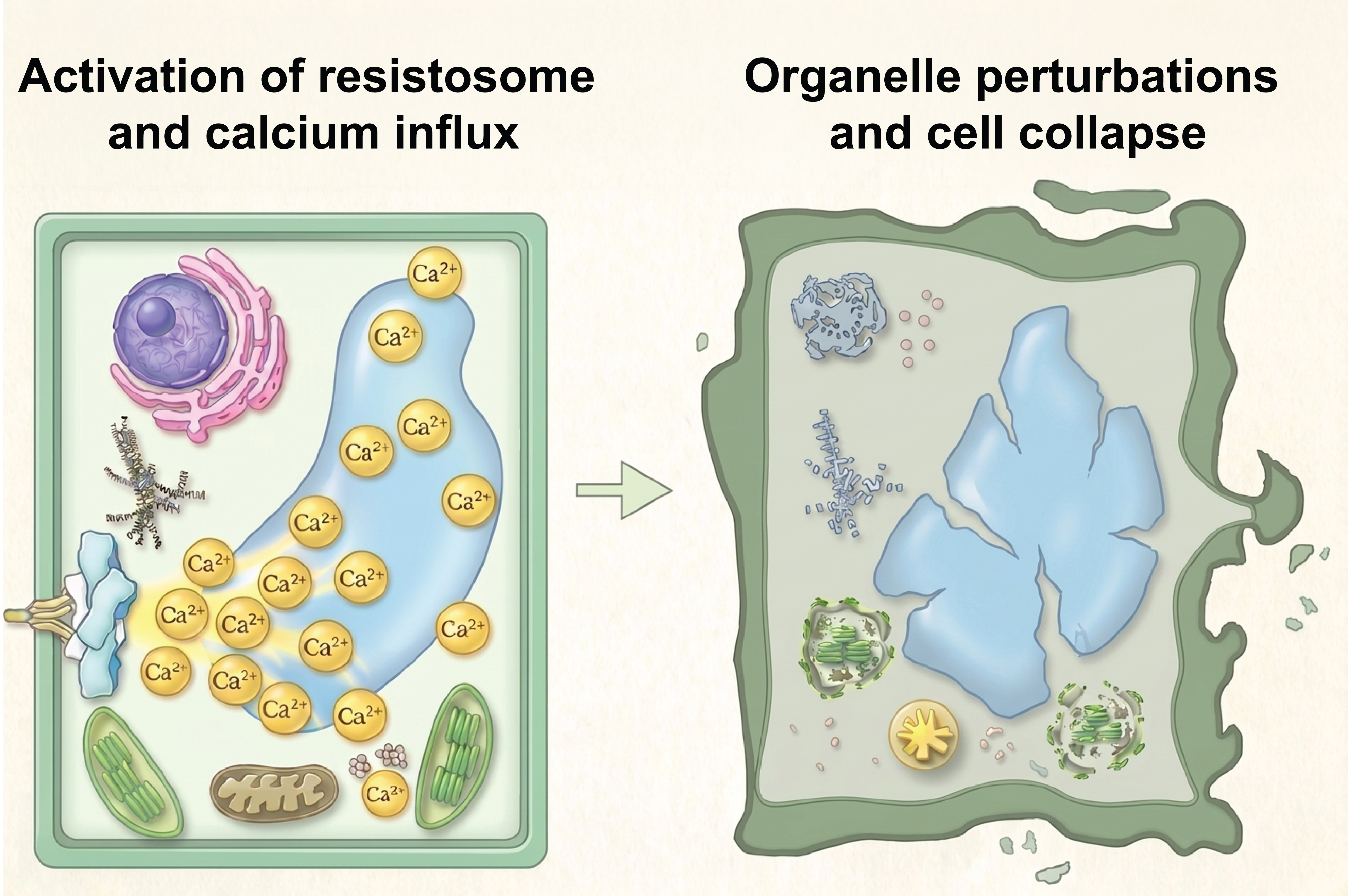
When plants encounter pathogen invasion, intracellular NLR immune receptors rapidly assemble into “resistosomes” to initiate defense responses. However, a central question has long remained unresolved: how does resistosome activation drive cells toward hypersensitive cell death?
In this study, we employed high-resolution live-cell imaging to construct, for the first time, a comprehensive spatiotemporal map of cell death following resistosome activation. Our findings reveal that this process is a highly ordered cascade of events. It begins with a rapid influx of intracellular calcium ions, followed by disruption of organelle dynamics. This is succeeded by cytoskeletal disassembly, ultimately leading to nuclear shrinkage and vacuolar collapse, completing the hypersensitive cell death response.
This work establishes a mechanistic framework for the execution phase of plant immune cell death, demonstrating how resistosomes precisely coordinate multiple structural changes across space and time to convert immune signals into an irreversible cellular fate. This represents a significant advance in our understanding of plant innate immunity and provides a solid theoretical foundation for future efforts to fine-tune disease resistance in crops.
The co-first authors of this study are research assistant Yi-Feng Chen and Master’s student Kuan-Yu Lin.
Subcellular calcium dynamics and organelle perturbations in resistosome-mediated cell death