[Phoebe Yu-Ying Hsieh] Magnesium Wars: How Microbial Competition Sparks Super-Resistant Bacteria
POST: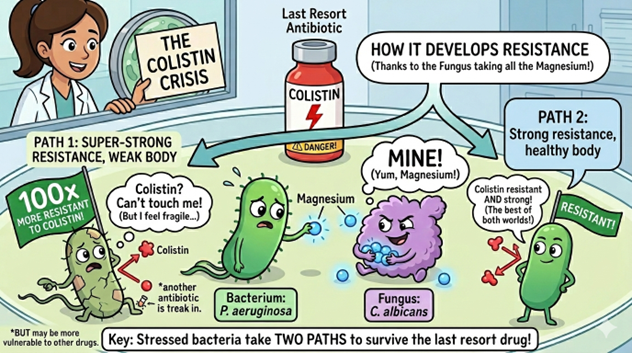
(Generated by Gemini AI based on our summary in English)
Antibiotic resistance is one of the biggest threats to modern medicine. Colistin is often used as a last-resort antibiotic to treat bacterial infections when other drugs fail. Unfortunately, some bacteria are becoming resistant to this powerful treatment. In this study, we discovered that a common fungus, Candida albicans, can indirectly help a bacterial pathogen, Pseudomonas aeruginosa, become highly resistant to colistin.
How does this happen? Both microbes compete for magnesium — an essential cation. When the fungus depletes magnesium from the environment, it leaves the bacteria in a low-magnesium state. Surprisingly, this magnesium shortage pushes the bacteria to evolve resistance. Over time, they develop genetic changes that dramatically increase their resistance to colistin — in some cases nearly 100 times higher than before. We found that the bacteria can take two different evolutionary paths: One path gives very strong resistance but comes at a cost: the bacterial outer membrane becomes weaker, making the bacteria more vulnerable to other antibiotics. The other path also increases resistance, yet without weakening the bacterial membrane. In both cases, the bacteria survive by altering the structure of their outer membrane so that colistin can no longer attach effectively.
Our findings show that interactions between microbes — not just antibiotic exposure alone — can drive the evolution of extreme drug resistance. This means that in real-world infections, especially those involving multiple microbes, bacteria may gain resistance in unexpected ways. By uncovering the mechanisms by which bacteria evolve antibiotic resistance in the presence of other microbial partners, we can identify new strategies to ultimately eliminate super-resistant pathogens.
Hsieh Y-YP, O’Keefe IP, Wang Z, Sun W, Yang H, Vu LM, et al. (2026) Magnesium depletion by Candida albicans unleashes two unusual modes of colistin resistance in Pseudomonas aeruginosa with different fitness costs. PLoS Biol 24(3): e3003673. https://doi.org/10.1371/journal.pbio.3003673