[Ting-Ying Wu] Modular cytokinin evolution: Integrating heat stress and development during terrestrialization
POST: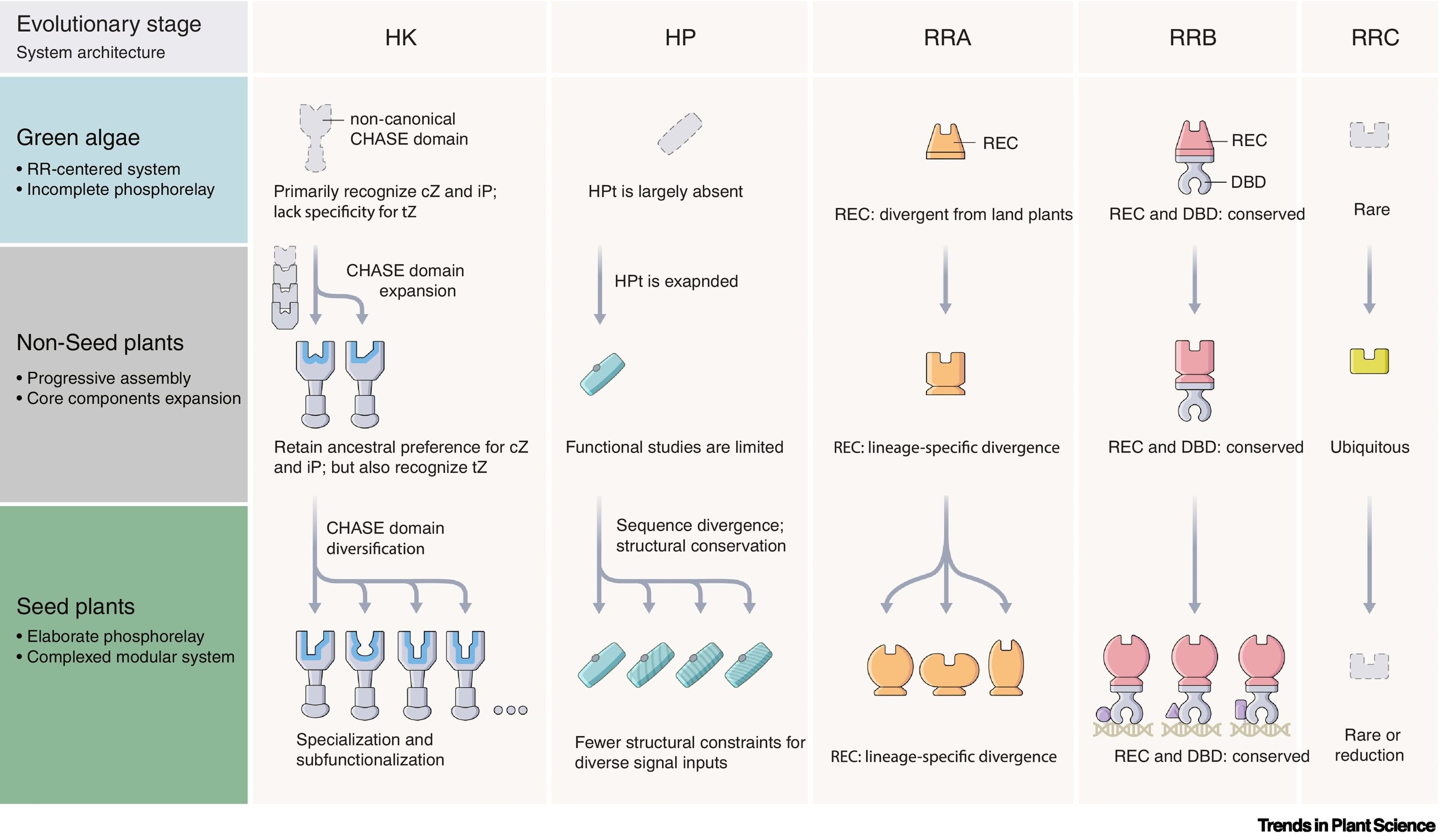
Modular assembly and functional co-option shaped cytokinin signaling evolution across land plants. (i) Stepwise assembly of the two-component system. Phylogenomics indicates that response regulators (RRs) predated the complete phosphorelay, suggesting the output module emerged before input perception. (ii) Mosaic evolution of signaling modules. Structural phylogenetic analyses reveal domain-specific evolutionary trajectories across perception (CHASE), transduction (HPt), and output (REC/DBD) modules, demonstrating that signaling components evolved under different evolutionary constraints. (iii) Evo-Physio metabolic shift in stress output. Comparative transcriptomics indicate a transition from an osmoprotection strategy via trehalose biosynthesis in early land plants to redox-centered and long-distance transport in angiosperms. The various purple shapes represent other factors, such as TFs, that might interact with RRBs. CHASE: Cyclases/Histidines Associated Sensory Extracellular; cZ: cis-zeatin; DBD: DNA-binding domain; HK: histidine kinase; HPt: histidine phosphotransfer protein; iP: isopentenyladenine; RRA: type-A RR; RRB: type-B RR; RRC: type-C RR; REC: receiver domain; tZ: trans-zeatin; TF: transcription factor.
Cytokinin signaling, long regarded primarily as a developmental regulator, has emerged as a central integrator of plant terrestrial adaptation. Comparative genomic and structural phylogenetics indicate a stepwise assembly of the phosphorelay, where receptor domains diversified alongside lineage-specific shifts in cytokinin usage, from cis-zeatin-enriched systems in early-diverging lineages toward trans-zeatin-dominant signaling in vascular plants, while downstream executors remained evolutionarily constrained. Cross-lineage transcriptomic comparisons under heat stress suggest a rewiring of physiological outputs. Although growth repression is deeply conserved, broader metabolic responses differ across clades: trehalose-associated osmoprotection in early land plants, whereas angiosperms transitioned to redox- and transport-based strategies. Overall, cytokinin signaling forms a modular framework that enabled early environmental buffering and was subsequently refined to support the complex architectures of vascular plants.